European and local government go hand in hand: Volt is growing in Darmstadt and across Hesse
Joint press release from the Volt faction and party, 19 March 2026
Die deutsche Version dieser Mitteilung findet ihr hier.
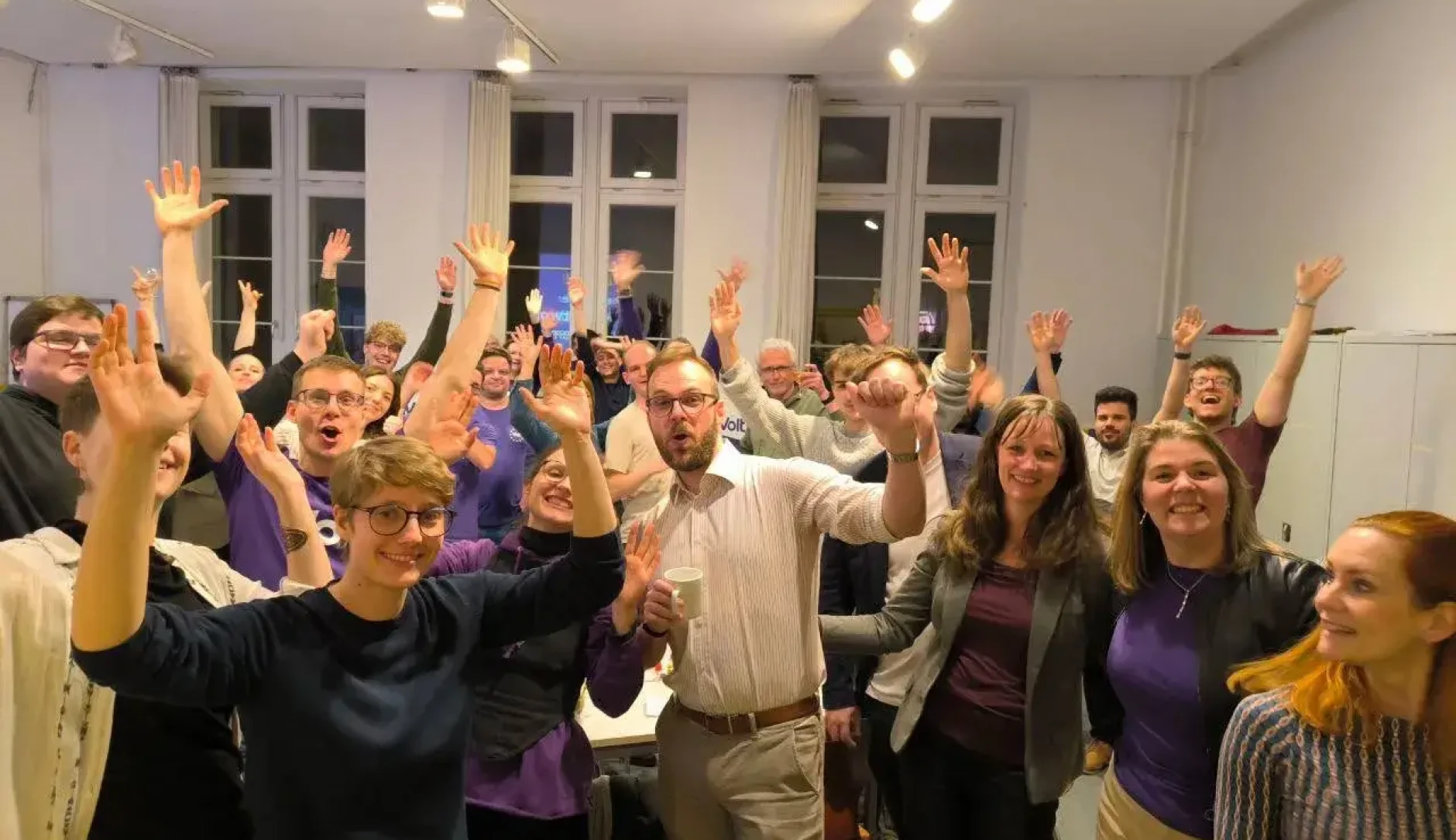
According to preliminary final results, Volt has secured 9.9% of the vote in Darmstadt, winning seven seats in the city parliament.
Across the Bundesland of Hesse, it is clear that Volt’s approach of European solutions and constructive, fact-based politics resonates with voters.
The newly elected representatives intend to implement this approach in key areas such as education, public spaces, administration, culture and mobility.
With just under 10% of the vote in the local elections, Volt has demonstrated that the pan-European party is firmly established in Darmstadt. Voters are making it clear that they want a new, constructive approach to politics and smart solutions. Volt is the only one of the three coalition parties to have made gains in this election. The fact that its pan-European focus also appeals to local voters comes as no surprise: “People are increasingly realising that what happens where they live is linked to the global political situation. Therefore, Europe is not an abstract project, but a political reality in everyday life – we work together across borders and devise solutions that have an impact locally,” explains Ana Lena Herrling, lead candidate and faction leader.
She adds: “We are very happy about the voters’ confidence in our policies. The fact that we are the only governing party to have made significant gains is, for me, a clear mandate: more of this European-oriented policy, not less. This also means that the work of Volt and our councillor Holger Klötzner should have an even greater impact.”
In the young and European-oriented city of Darmstadt, Volt achieved the party’s best result across Hesse and Europe. At the same time, it has also become clear in many other places that the party’s message is resonating: according to preliminary results, Volt has secured three seats each in Bensheim, Gießen, Fulda and Marburg. Volt can now send elected representatives into numerous district and town councils, where it stood for election for the first time. Volt also made gains in the other cities of the Rhine-Main Triangle: in Frankfurt and Wiesbaden, the party improved its results in each case and now stands at 4.8 and 4.4 per cent, respectively.
“As a party, we have grown out of the major cities. It is easier for young people in particular to organise themselves here,” explains Frederik Jobst, vice faction leader. “But now we can see that this is not the end of the story: our ideas are increasingly gaining traction in rural areas too. People of all ages are getting involved with Volt to bring these ideas into local councils. Through their voting decisions, people across Hesse are showing that they support this.”
Following the announcement of the election results, Volt is now focusing on dialogue with other parties. Berit Walter, current local lead of Volt in Darmstadt, comments: “The election results also show that there are no longer clear majorities in Darmstadt – it’s a close and diverse race. This makes it all the more important to establish a form of cooperation in which the different strengths of the parties are evident and, at the same time, we work constructively to find solutions for the city. To this end, we offer a style of politics without unnecessary drama, on an equal footing and with a clear focus on the best solutions for Darmstadt.”
“We do not wish to remain solely in government responsibility in Darmstadt, but want to continue our cooperation with the Volt-lead departments in Frankfurt and Wiesbaden. In particular, the jointly developed vision for a smart Rhine-Main 2030 must continue to be closely coordinated and consistently pursued in order to modernise and streamline administration in the Rhine-Main region as quickly as possible,” says Holger Klötzner, councillor for education and digitisation.
The new Volt faction, now comprising seven members, therefore intends to work closely with citizens during the coming legislative term to champion important issues such as good schools, a functioning administration and a city worth living in for everyone. The elected representatives for Volt are:
Ana Lena Herrling (36), water engineering specialist and faction leader, wishes to champion public spaces that offer room for everyone, and is convinced that the best results are achieved through collaboration.
Sustainability manager Berit Walter (42) has served as local lead of the party and advocates for fact-based, pragmatic decisions free from ideology. Her aim: to solve problems here and now for a city that works for everyone.
Computer science student Frederik Jobst (30), vice faction leader, is convinced that a functioning administration is the key to solving many problems: faster processes and freed-up capacity open up options for action, for example in the areas of climate and mobility.
Traffic planner Ann-Kathrin Bersch (34) is now joining the city parliament for the first time and will advocate for a mobility system that works for everyone and leaves room for quality of life and green spaces.
Chemist Justin Krampe (28) is a PhD student at TU Darmstadt and also a new addition to the faction. He advocates for evidence-based decision-making and will champion policies that are developed in consultation with the city’s residents, particularly in the cultural sector.
Also new to the faction is Anna Schilling (30). The sustainability manager has previously supported Volt elected officials across Germany in their work and will now bring good ideas and insights from other cities to Darmstadt.
Computer science student Franziska Schäffer (27) has been a member of the faction since 2023, where she has been particularly involved in digitisation and education. She wants to continue to advocate for digitisation and an efficient administration that can purposefully and quickly solve people's problems.